 CamerAcademy
 Dave Maguire
Three shots is the smallest amount of filming that turns a thing you recorded into a scene somebody watches.
A single shot is a sentence
Nearly everyone films their first video the same way. Press record, follow the thing that is happening, press stop when it stops. Everything you needed is in there. It still plays back like security footage.
Nothing is wrong with the shot. The problem is that there is only one of it. A single shot is a sentence. Coverage is a paragraph, and a paragraph is the smallest thing that can carry an idea.
A cut is the only way you have of saying look at this now. Without one, every part of the frame carries equal weight, the viewer has to decide for themselves what matters, and what they mostly decide is to stop watching.
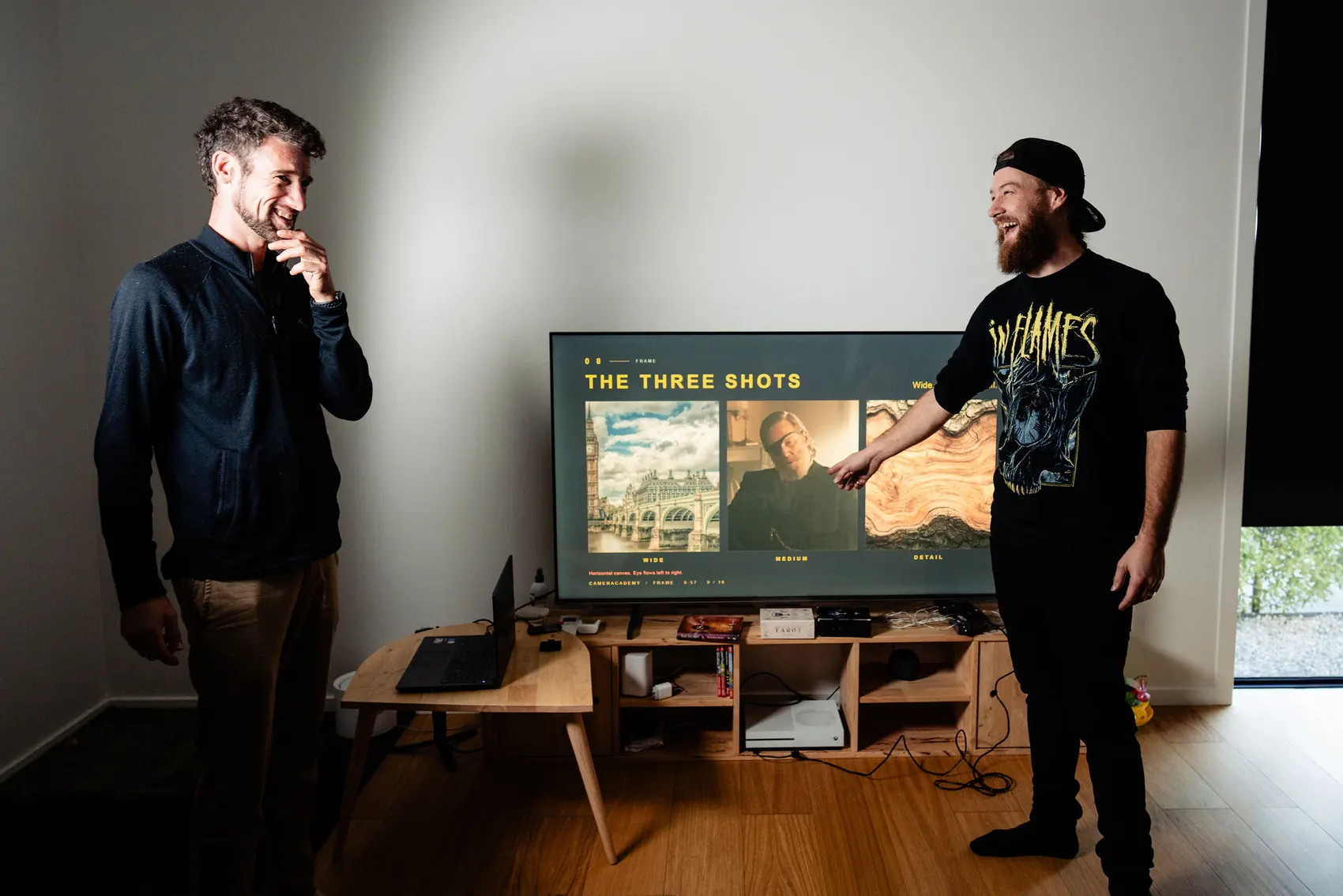
Three shots is the least coverage that fixes it. Wide, medium, close. On the slide in class the third one is labelled detail, which is nearer to what it actually does.
Wide: where we are
The wide does one job. It tells the viewer who is here, where here is, and how far everything sits from everything else. Until that is settled a viewer is working it out instead of watching, and they keep working it out until you show them.
It is also the shot people skip, because it is the least interesting one to stand there and film. Shoot it anyway, and shoot it first. It is the only one of the three you cannot invent afterwards: you can always move closer, but you cannot move back once you have packed up and gone home.
Get far enough back that the whole action fits with room around it. If you are pressing into a wall to make it fit, that is not a wide, it is a loose medium.
Then hold it longer than feels comfortable. You already know what is in the frame, because you are standing in it. Your viewer is seeing the place for the first time and needs a couple of seconds to read it.
Medium: what is happening
The medium is the working shot, and most of any scene lives in it. Roughly waist up on a person, or the action plus the hands doing it. Close enough to read a face, wide enough to see what that face is reacting to.
This is the shot that carries the information. If someone is making something, the medium is what shows you what. If two people are talking, the medium is what shows they are talking to each other rather than past each other.
It is the easiest of the three to shoot and the easiest to get lazy with. A medium that drifts wider on every take, because you kept stepping back to fit something in, leaves you with three near-identical shots that all cut badly against one another.
Close: what it means
The wide and the medium report. The close has an opinion. It is where you stop describing a scene and tell the viewer which part of it matters, and it is the only one of the three that makes anybody feel anything.
Two things are worth going close on. A face, for the reaction, which is almost always more interesting than the thing being reacted to. And a detail, for the object the scene turns on: the hands, the tool, the thing that breaks.
Then actually go close. A timid close-up is just a medium, and a frame that cannot decide which it is will always be weaker than either of the two it is sitting between.
Spend them carefully. Every close you cut to is a promise that this is the important bit. Three in a row is three promises, so none of them land.
One moment filmed three times, not three moments
This is where most first sequences come apart, and it is not a framing problem at all.
People film the wide of the beginning, the medium of the middle and the close of the end. They get home with three shots that are each perfectly good and discover that not one of them will join to another. Three different moments. Nothing overlaps, so there is nowhere to put a cut.
Run the whole action in every size. All of it, start to finish, three separate times. Doing it again feels wasteful and it is the entire reason the edit works: wherever you later want to change size, both shots cover that same instant and the cut is already there.
Then give yourself the handles. Roll three seconds before anything happens and hold three after it finishes, on every take, without deciding each time whether this one needs it. Boring on set is beautiful in the edit, and those six seconds are where every cut you eventually make is going to come from.
Two ways three shots still fail
- The shots are too alikeCut between two frames of the same subject at nearly the same size from nearly the same spot and the subject appears to twitch. Change the size by a real amount and move your feet as well. The working number is thirty degrees around the subject, minimum. Zooming from where you already stand is what causes the twitch, not what cures it.
- You wandered round the backPick a side of the action and stay on it. Cross to the other side between shots and everything flips: the person who was walking left to right is now walking right to left, and someone looking at someone else is suddenly looking away from them. A viewer cannot name what went wrong, and knows perfectly well that something did.
Both come down to the same discipline: deciding where you will stand before you press record rather than after.
Ten minutes and an ordinary action
Pick something small you can repeat as often as you like. Pouring a coffee. Unlocking a bike. Lacing a boot.
- Film it three timesWide, medium, close, with the whole action in each one rather than a piece of it.
- Three seconds either endBefore and after, on all three takes, no exceptions and no judgement calls.
- Move between sizesWalk to a new position rather than zooming from the old one, so the angle changes along with the size.
- Cut them in orderWide, medium, close, on your phone, in whichever editor is already installed. About nine seconds.
Watch it once. Then do what we do in class with everything: pick the weakest of the three, say out loud why, and go and shoot that one again. Shoot, watch, find the weak one, go again. That is the whole job, and it does not change at any level above this one.
If your single frames are still coming out lifeless, that is a separate problem and worth sorting first, and composition is week three of Camera Fundamentals. This one only starts once your frames are good and still will not cut together.
Coverage is Level 03
Story in three beats, the full set of coverage, and your own eight-shot scene shot and then cut on the big screen to find where it breaks. One 3-hour session, max 6.
See Cinematic StorytellingDaveFounder, CamerAcademy Queenstown